

The Polynesian triangle encompasses 10,000 square miles of ocean, with Hawaii at the north corner, Aotearoa at the west corner, Rapa Nui on east corner, and hundreds of islands within the triangle’s parameters. History shows that the inhabitants of the Polynesian triangle were peoples of a common language and ancestry. In geographical terms, the Polynesian triangle is called the largest “nation” on earth, so it was an amazing feat that the Polynesians navigated across such massive ocean distances without using even the crudest of navigating instruments! How did they know where to go and how to get there?
In this COVID climate, leaders may often feel like they too are venturing into 10,000 square miles of fluid I-Don’t-Know space without a map to help them achieve what seems a very fuzzy vision or destination. Wayfinding, the Polynesian navigating system that has been passed down through generations, enabled them to discover and connect with peoples across unknown divides. So Polynesian voyagers can certainly teach us useful lessons and valuable insights for leading in the space of I-Don’t-Know-ness.
What is Wayfinding?
Wayfinding is a Polynesian navigating method that does not use any scientific instruments; rather, it is a way of finding reaching a target using the navigator’s constant observing of and constant adjusting to the natural environment. With the destination in mind, a navigator interprets real-time data from the environment and continually responds with adaptive decisions and re-orients the path as needed. Grounded in generations of wisdom, the Poloynesian’s ability to recognize patterns as habits, trends, and indicators create, in essence, a living mental map that intuits messages found in the sun, moon, stars, waves, birds and more.
Think of Wayfinding as a navigator’s multi-sensory compass based on direction, speed and time.
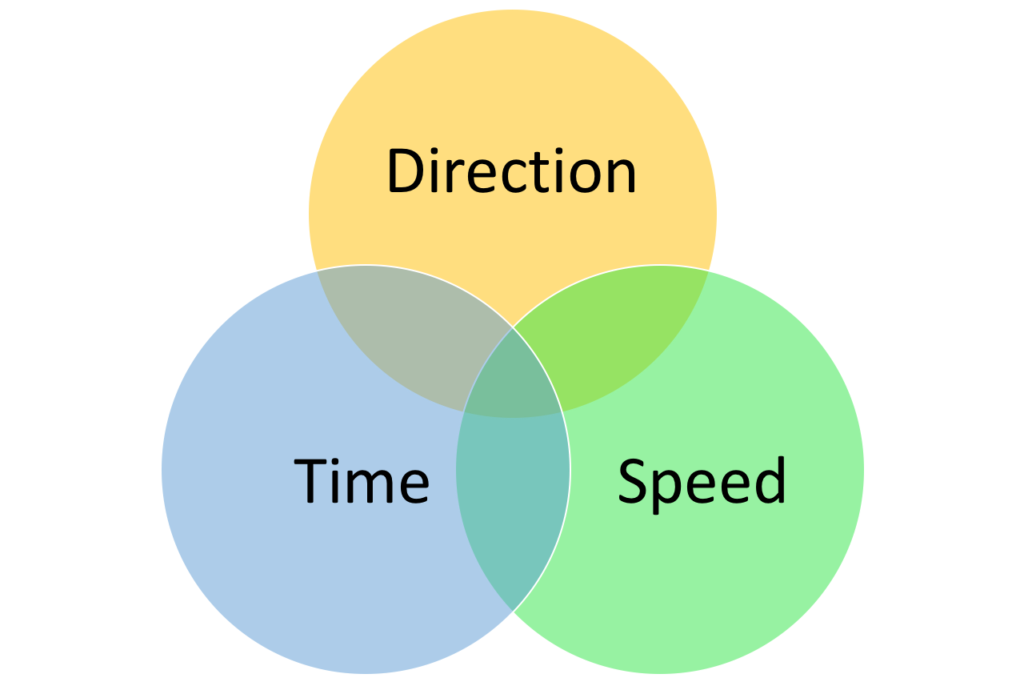
- Direction: Where, Why, and How
Without a scientific instrument, how does a navigator know the direction toward the destination – immediate or longer term? The answer lies in astute noticing, sensemaking, interpreting, and responding to systemic patterns found in symbols and signs, not in isolation, but over time. That takes wisdom developed through experience. For example, where is the sun relative to the horizon? What color is the ocean in the morning, noon, or evening? How long and wide is the sun path on the water? How do the wave patterns and the behavior of dolphins and birds change when land is near? All provide direction data.
Just as leaders set a vision that paints a picture of the desired outcome for a project or the organization, Polynesian navigators set their direction pointed toward reaching a final destination; yet for leaders and navigators, final destinations cannot be reached by sailing directly as the crow flies, or as one big push. Instead, informed by the overall goal, intermediary milestones guide progress in the chosen direction. In other words, with a fuzzy vision, a navigator sets sail for a box, a closer target area that sets up the next leg. Upon reaching the box, sites are re-oriented for the next box.
For both the navigator and the leader, wide expanses of the unknown are approachable and targets achievable when noticing systems in action.
- Time: Trends and Dynamic Resources
Sunrise and sunset are times of the day that are full of clues for the navigator. Winds and waves give data, especially when weather conditions block the sun. Stars and constellations rise and set and help keep the direction on track. As with all the environmental data, none of the clues carry meaning in isolation; noticing the patterns among the elements across time is what’s important.
Like navigators, leaders pay attention to trends, both short term and long term, in order to guide decision and directions. Without, I-don’t-know-ness can feel overwhelming and almost paralyzing. Leveraging dynamic resources always available, leaders can re-orient their decision making with agility.
- Speed: Pace of movement
Using scientific instruments, speed is measured by time x distance. How can pace of movement be assessed without instruments? How about using the self as an instrument? Without any scientific instruments, Polynesian navigators gauge speed by the feel of the wind against the body, size of white caps on the water, size of swells, and the sound of rushing wake. Not any one sign tells the story; multi-source sensing and interpreting patterns provide the metrics that ensure the navigators are getting where they want to go at the safe and appropriate pace.
Leaders frequently respond to the state of I-Don’t-Know-ness with a sense of urgency to find comfortable clarity because they fear they are not making progress fast enough. Or they are moving fast, but is it the right direction? Together with direction and time, pace is a critical part of the Wayfinding compass.
The Navigator is a part of the Wayfinding System
Have you noticed that the navigator himself is part of the system of data used to determine direction, time, and speed? As important as constant observation and adjustment to the external environment are to Wayfinding, the navigator’s internal noticing capacities are equally crucial.
Master Polynesian navigator, Nainoa Thompson, describes, “There is a deep connection inside my abilities and senses that goes beyond the analytical, beyond seeing with my eyes”. Confronting the need for control and the fear of not knowing, three lessons effectively combat the self-saboteurs that navigators, like leaders, can fall victim to:
- Create quiet in yourself. This opens up listening to all senses, both external and internal, and puts you in the space of receptivity.
- Trust yourself. Let go and “give up fighting the moon”. Let go of trying to control; instead tap your wisdom learned from experience.
- Unbind your confidence. Recognize the warm calm that you feel when you release the tension and panic brought by not knowing, and remember your successes.
In the space of I-Don’t-Know-ness, the compass a leader needs is not the scientific precision instrument that is finely calibrated to indicate navigating direction. Believing such an instrument exists in the current complexities that are here to stay is almost delusional! The Polynesian art of Wayfinding shows that the most powerful and reliable compass is “na’au, that is, the knowledge of the heart” (Polynesian Voyaging Society, 2019).
Links to more information about Wayfinding and Polynesian navigating
Polynesian Voyaging Society. Retrieved from https://www.pbs.org/wayfinders/polynesian8.html.


